

Invest. Build. Grow in North Omaha.
Conduit Bonding & Development Incentives
The Omaha Inland Port Authority can use its revenue bonding authority to support qualifying economic development projects within the Port district.
Through a conduit bond transaction, OIPA takes legal title to an eligible project and then leases the property back to the company or developer. This structure can provide significant project-cost savings while helping businesses make investments that create jobs, expand commerce, redevelop property, and strengthen the Port district.
OIPA is authorized under Nebraska's Municipal Inland Port Authority Act to issue negotiable revenue bonds and obligations in support of qualifying projects, including the purchase, construction, rehabilitation, and installation of projects.
Conduit Bonding
What is conduit bonding?
Conduit bonding is an economic development tool that allows OIPA to facilitate qualifying private investment through a public-private financing structure.
In a typical OIPA transaction:
| OIPA's Role | Developer/Company's Role |
|---|---|
| OIPA issues revenue bonds supporting the project. | The company provides or arranges the capital required to construct or rehabilitate the project. |
| Legal title to eligible project property is conveyed to OIPA for the incentive period. | The company develops and operates the project. |
| OIPA leases the project back to the company. | The company makes required lease, PILOT, administrative, and other agreed payments. |
| OIPA oversees compliance with the approved incentive agreements. | The company documents eligible project investments and complies with the approved transaction documents. |
| At the conclusion of the incentive or an approved early purchase, the property can return to company ownership. | The company may exercise its purchase option subject to the transaction documents. |
The company's project investment is represented through the revenue bonds as eligible costs are incurred. Construction itself is generally funded through the company's own capital, third-party financing, or another independent source; the conduit bond structure is not described in the documents as OIPA making a conventional loan to the developer.
Conduit bonding is an incentive structure—not a traditional OIPA loan.
Its value comes primarily from reducing eligible project costs and creating a structure that may make additional private financing more feasible.
How could conduit bonding help my project?
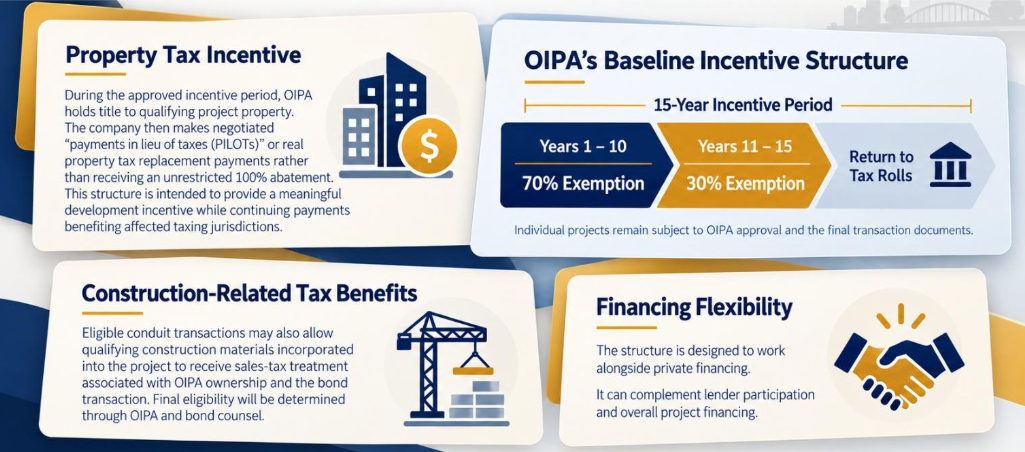
OIPA Incentive Structure and Benefits
- Property Tax Incentive: During the approved incentive period, OIPA holds title to qualifying project property. The company makes negotiated "payments in lieu of taxes (PILOTs)" or real property tax replacement payments rather than receiving an unrestricted 100% abatement.
- OIPA's Baseline Incentive Structure: A 15-Year Incentive Period split into Years 1–10 (70% Exemption) and Years 11–15 (30% Exemption), after which projects return to tax rolls. Individual projects remain subject to OIPA approval.
- Construction-Related Tax Benefits: Eligible conduit transactions may allow qualifying construction materials incorporated into the project to receive sales-tax treatment associated with OIPA ownership and bond transactions.
- Financing Flexibility: The structure is designed to work alongside private financing, complementing lender participation and overall project financing.
Is conduit bonding right for your project?
Conduit bonding may be worth exploring if your organization is considering a significant investment (Approximately 10 million+) within the Omaha Inland Port Authority district involving:
- new construction or substantial rehabilitation;
- industrial, commercial, logistics, manufacturing, innovation, or other economic development activity consistent with OIPA's statutory purposes;
- significant private capital investment;
- job creation or retention;
- redevelopment of underutilized property;
- infrastructure or facility investment; or
- a project where reducing long-term occupancy or development costs could materially improve financial feasibility.
All projects are evaluated individually. Participation is not guaranteed, and preliminary discussions with OIPA do not constitute approval of an incentive.
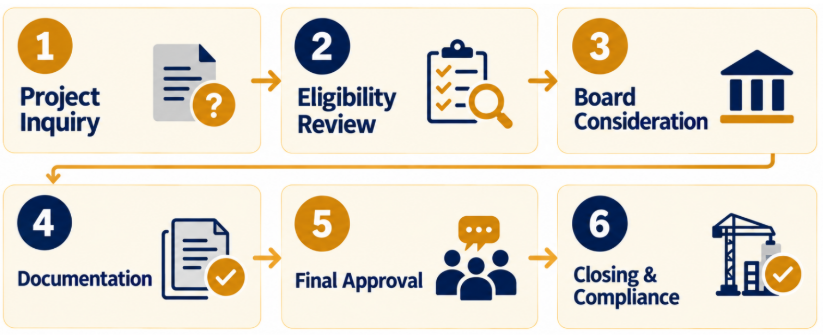
- Project Inquiry
The company provides OIPA with preliminary information about the proposed project, investment, location, ownership, financing, development schedule, and anticipated community and economic impact.
- Eligibility & Project Review
OIPA staff reviews the project for statutory eligibility, location within the Port district, alignment with OIPA development goals, anticipated public benefit, and consistency with Board policy.
- Preliminary Board Consideration
If OIPA elects to proceed, the Board may consider an Inducement Resolution, establishing OIPA's preliminary willingness to move forward and the framework for continued negotiations. The inducement resolution is not the final authorization of the bond transaction.
The current policy requires the Funding Agreement Deposit to be paid before consideration of an inducement resolution or other Board action.
- Structuring & Documentation
OIPA, its bond counsel, the company, company counsel, lenders, and other necessary parties develop the transaction documents. These can include a Trust Indenture, Bond ,Purchase Agreement, Lease Agreement, Incentives Compliance Agreement, tax documentation, financing agreements, and related instruments.
- Public Process & Final Approval
Following required notice and public process, the OIPA Board considers final approval of the proposed bond transaction and applicable agreements. The counsel memorandum contemplates a public hearing followed by consideration of a final Bond Resolution.
- Closing, Construction & Compliance
After final documentation and approval, the transaction closes and bonds are issued. As eligible development costs are incurred, project investments are documented through the bond and trustee process. OIPA's policy requires controls over certification and disbursement of bond proceeds and ongoing reporting.
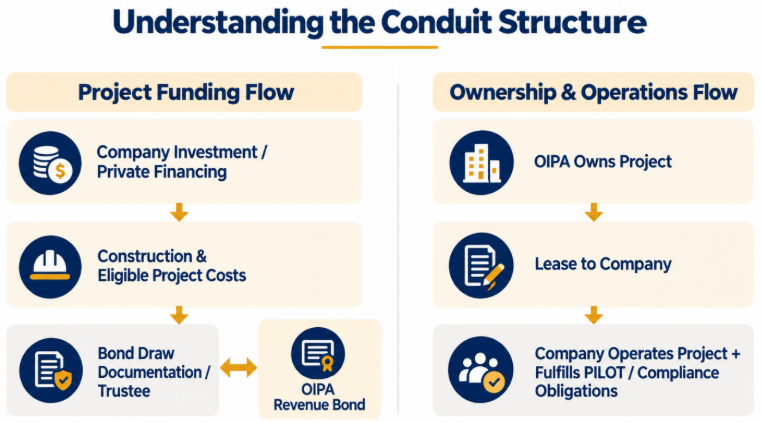
OIPA facilitates the incentive structure; the company remains responsible for financing, developing, operating, and complying with the project agreements.
Understanding the Conduit Structure
Project Funding Flow
- Step 1: Company Investment / Private Financing
- Step 2: Construction & Eligible Project Costs
- Step 3: Bond Draw Documentation / Trustee, linked with OIPA Revenue Bond
Ownership & Operations Flow
- Step 1: OIPA Owns Project
- Step 2: Lease to Company
- Step 3: Company Operates Project + Fulfills PILOT / Compliance Obligations
Current Conduit Bond Fee Schedule
| Fee | Current Policy |
|---|---|
| Funding Agreement Deposit | $20,000 |
| Bond Issuance Fee — first $10M | 0.375% |
| Bond Issuance Fee — next $15M | 0.250% |
| Bond Issuance Fee — remaining amount | 0.125% |
| 501(c)(3) Bond Issuance Fee | Maximum $60,000 |
| Bond Counsel — issuance under $15M | $0.95/$1,000; minimum $12,000 |
| Bond Counsel — above $15M through $50M | $14,250 + $0.45/$1,000 above $15M |
| Bond Counsel — above $50M through $100M | $30,000 + $0.30/$1,000 above $50M |
| Bond Counsel — above $100M | $45,000 + $0.15/$1,000 above $100M |
| Outside Counsel | Actual invoice |
| Trustee | Actual invoice |
| Annual Administrative Fee | 3.5% of total averaged annual ad valorem exemption value; or, where no property-tax exemption is provided, 3.5% of total amount paid annually to debt |
| Sales Tax Exemption Fee | 2% of estimated sales-tax savings |
| Certain amendments/consents/actions | $2,500 supplemental fee |
| Rescheduling after executed documents have been delivered for issuance | $3,000 supplemental bond counsel fee |
*Fees shown are based on OIPA's current Bond & Debt Issuance and Disbursements Policy and are provided for planning purposes only. Actual fees, professional costs, project obligations, and incentive terms will be established through the applicable agreements and approvals.
Incentives come with measurable obligations- OIPA's conduit bonding program is structured as a partnership. Companies receiving development incentives are expected to fulfill the financial, development, reporting, and community commitments contained in their approved agreements.
Public investment. Private commitment. Measurable accountability.
What is a conduit revenue bond?
A conduit revenue bond is a financing instrument issued by OIPA in support of an eligible economic development project. In the typical structure contemplated by OIPA's counsel, the company itself may serve as bondholder while documenting its qualifying investment through bond draws.
Does OIPA give the developer the money to build the project?
Not under the typical structure described in OIPA's conduit bond framework. Construction is funded through independent sources such as private financing or the company's own capital. The bond transaction documents the eligible investment and creates the structure through which the approved development incentives are provided.
Is OIPA responsible for repaying the company's debt?
The typical conduit structure is designed so that OIPA does not assume the company's conventional financing obligation. The counsel memorandum states that OIPA has no financial obligation on the conduit bonds in the described company-as-lessee-and-bondholder structure.
For the website, I would still have bond counsel approve that exact FAQ language before publication because OIPA's broader debt policy also contemplates other structures involving specifically pledged Port revenues.
Does the company receive a 100% property-tax abatement?
Generally, no. Although OIPA ownership may create an exemption for qualifying property, the company enters into an agreement requiring annual PILOT or tax-replacement payments. OIPA's current baseline template provides for a 15-year incentive structured around 70% exemption for years 1–10 and 30% for years 11–15.
Can construction materials receive a sales-tax benefit?
The documents contemplate potential sales-tax treatment for qualifying construction materials incorporated into an eligible project. Actual eligibility and savings depend upon the transaction and applicable law and should be confirmed through OIPA and bond counsel.
How long can an incentive last?
OIPA's current recommended baseline is a 15-year structure, subject to final project approval and transaction documents.
Does my project have to be located in the OIPA district?
Project location is one of the statutory and policy considerations OIPA staff reviews as part of eligibility. A potential applicant should contact OIPA before assuming that a particular property or project qualifies.
Do I need my financing in place before contacting OIPA?
Not necessarily, but OIPA's transaction needs to be coordinated with acquisition and private financing. Early communication between the company, OIPA, bond counsel, and the company's lender can help avoid conflicts between the incentive structure and lender requirements.
Can a lender take a mortgage on the project?
The proposed structure contemplates lender security interests and mortgage arrangements and includes protections such as notice and cure rights. The precise lender rights are established through the project's transaction documents.
Can the company buy the property back?
The conduit bond framework contemplates a purchase option allowing the company to acquire all or part of the project, subject to payment or cancellation of outstanding bonds and satisfaction of applicable fees, expenses, and PILOT obligations. OIPA would then convey the applicable property back to the company and the related incentive would terminate.
Can an incentive be transferred if the project is sold?
Certain assignments or transfers may be permitted under the transaction documents, particularly in connection with project financing, but assumptions of the project's obligations and OIPA approval may be required depending on the transaction.
What happens if the company fails to meet its obligations?
OIPA may suspend or terminate incentive benefits in accordance with the project's agreements. The current agreement template permits suspension of the real property tax exemption during an uncured default and provides for termination following an uncured Suspension Notice.
Are incentives automatically approved if a project qualifies?
No. Eligibility review is only the beginning of the process. The OIPA Board considers preliminary inducement and ultimately the final transaction and bond authorization.
How do I get started?
Contact OIPA for a preliminary project eligibility review. Be prepared to discuss your project location, total investment, proposed development, financing, timeline, expected job creation, and anticipated economic and community impact.
I would not call this button "Apply Now" yet, because the counsel memorandum says the formal application process is still “to be developed in coordination with Staff.”
Use "Request an Eligibility Review" until OIPA has adopted an application.
Bond & Debt Issuance and Disbursements Policy
Board-approved August 6, 2026; includes OIPA's procedures, controls, fees, and disbursement requirements.
OIPA Conduit Bonding Overview
Counsel memorandum explaining the proposed conduit structure, developer obligations, lender coordination, legal framework, and typical transaction structure.
Incentives Compliance Agreement – Template
OIPA's recommended agreement framework governing the incentive period, payments, compliance requirements, defaults, and other project obligations.
Conduit Bond Project Information Form / Application *Being Drafted*
Have a project in the OIPA district?
Our team can help you determine whether conduit bonding and OIPA development incentives may be appropriate for your proposed investment.
Request a Project Eligibility Review
Submitting project information does not constitute approval of an incentive, inducement, bond issuance, or financial commitment by OIPA. All projects remain subject to eligibility review, negotiation, legal review, applicable public processes, and approval by the OIPA Board of Commissioners.